From your summary on the social media, people are already talking of what an awesome life journey you have had, to this point. But you said that was a scratch. We will love the details.
I had a very humble beginning, born in the riverine setting of Ode-Etikan in Ilaje Local Government Area of Ondo State. At that time, there was nothing like cars, motorcycles or any other motorised mode of transportation. The best we had was the outboard engine, which was used only for fishing in the ocean. Later on, the government engaged Westminster Dredging Company to dredge a canal to pass through the entire local government area. So, I was not exposed to any form of development and had no opportunity to experience life in its fullest.
But I fully remember that my parents, especially my mother, loved education, as the education supervisors used to stay in our house and my parents were always urging me to watch them by sitting by their tables. And God helped me that I was very brilliant in my primary school days. My father was a founder of a church and he was also involved in large scale farming. So, we used to accompany him to the farm by trekking long distances and then come back together to continue schooling.
I remember that one day my mother was brought from the farm to the church for prayers. She was very weak and weary, looking very frail. I didn't know she was in labour. That continued for two days. I was asked to go and join my grandmother in another village. All I got to know later on was that she was being taken to the local government headquarters in Igbokoda for treatment. It was much later that I got to know that she had passed on. It was a very painful moment for me, especially as I didn't get to see her in her days of severe pain. The child in her womb also died. She was being conveyed in a local canoe and she died on the way. I was in primary five or so at the time and it became an issue in the house as my step mother became very hostile and uncaring.
She would starve me of food, compel me to do very tedious menial jobs in the house, even though her children were much younger than me and then she was never satisfied with anything that I did and was inciting my father against me to hate me. I couldn't take it any longer so one night I ran away from the house, far into the forest. My wish then was that I would run into some wild animal that would just devour me so I could just end life. Unknown to me, my father had roused up the entire village to constitute a search party for me. Local hunters and farmers were all mobilised to search me out but I had gone very far into the forest so they couldn't locate me. An idea cropped into their mind in the village to use the huge bell of the Anglican Church, which they were ringing intermittently. It was the sound of the bell that I followed and was able to come back home because at that time I was already lost and starving in the thick forest. But the persecution continued and even increased.
My aunties came to my father and sought his permission to take away my younger sister to go and be living with my grandmother in another village and my younger brother was also taken away by one of my aunties. But my father would not release me, being the first born of my mother. One particular night, I decided to end it all. My father also had many fish ponds at the back of our compound. Around midnight of that day, I ran into one of the fish ponds to drown deliberately. So, I started guzzling mud water just so that I may die. I didn't know what happened thereafter. I woke in a hospital where I had been unconscious for seven days. My father stayed with me throughout because at this time, my aunties had raised the alarm to hold him responsible for any harm that may befall me.
Based on the persecution that I was facing at home, my father decided to take me to a boarding house, far away from home, for my secondary education. I was too young for that experience and he just sort of dumped me there. All my provisions and necessaries were confiscated by my seniors and I was left with only my toothpaste which I reserved for licking in order to get my tommy to protrude and avoid starvation. I could not cope really, so I had to find a way to survive. I joined a cart-pushing company and overtime, I dropped out of school and left boarding house to be staying with the owner of the company. I did this for about one year and had actually forgotten the idea of schooling as I had mastered the art of manual truck-pushing. We were transporting local gin for export to Lagos. So once in a while I joined in the drinking and eventually became wild and very rascally. It was one of my townsmen who saw me in this condition that went back home to tell my father my plight. My father came and took me home and registered me in another school to complete my secondary education.
At this time, my step mother could no longer oppress me as before but we were not on very good terms and my father noticed it, so after my SSCE exams, he sent me to his younger brother in Lagos for further studies.
Now my uncle was a timber dealer so I joined him in the timber business and I did that for about five years. We adopted a boundary town between Ondo and Edo States, called Owan, as our base. From there we would travel by boat to Ofenitebe, a village in Edo State on the opposite side of the Ogbese River. From there, we go into the forest in search of timber logs. During the dry season, we cut the logs and then dig very deep trenches near them, so that when the rain starts falling, we drag the logs manually to the Ogbese River. Ogbese is a narrow flowing river with very fast current. So, each of us will take charge of one log at a time, to row it with manual poles and guide it along the current. It takes about a month's journey to get to Nikrogha, which was then our terminal for manual rowing. At Nikrogha, we would then assemble all the logs and raft them together with strong wires. Then tug boats would come from Lagos to hook the logs and tow them to Lagos. At Nikrogha, we then build houses with palm leaves, make local beds on top of the logs, to journey to Lagos. It takes about three months to get to Lagos. The challenge is when the logs scatter, especially in deep waters after Epe, as we had to come through the Atlantic Ocean enroute the Lagos Lagoon and then stop at Okobaba Foreshore in Ebute-Metta in Lagos. You wake up at times with snakes under your bed and you are there in the rain and in the sunshine. Your major task is to protect the logs and keep them intact till we get to Lagos.
I was adopted as the official cook of the team so I had additional task apart from logging. I was also the secretary, taking down notes and the number of logs. But in all of this, my mind did not depart from education as I didn't think I was born to be a timber man. So what I did was to buy textbooks and keep faith with my studies even though I had no idea of how it would end. Having worked for about five years, I indicated to my uncle that I wanted to further my education. So, I gathered money from my pocket money and borrowing from a friend to register for the GCE exam, which I took and passed. I then also enrolled for JAMB and passed and was offered admission to study law at the Obafemi Awolowo University (OAU) Ile Ife. At this point, my uncle had fallen in love with me totally as he loved lawyers and I was the first person in the family to venture into that field.
Your story is already inspiring a lot of people. Was there any point in the past that it looked as if today, would not be, when you felt like walking away from your dreams and destiny?
Surely I had so many discouraging moments in my life journey, especially in my early childhood days. But what I see in it all is that if God has destined you for a particular thing, you will surely get there. Looking back now, all that I went through was actually to prepare me for where I am presently in my career and ministry. It couldn't have been so sweet should I have walked through it all so freely and smoothly. The joy I feel presently is in looking back at it all and realising that in spite of all that I went through, I am still here. What that means then is that no matter what is happening to you, as long as you are still breathing, don't give up.
For someone with your background, one would expect a quiet, please-let-no-one-notice-me-here kind of life at Ife. But no, it was Big Sam, Big Sam everywhere. Why did you choose to behave like that proverbial fellow who wakes up everyday seeking to be killed, considering that the history of student activism is replete with abrupt termination of academic careers and disruption of future plans?
I didn't just choose to be an activist in my university days in Ife. Two things I can now recall accounted for this. First is the influence of Professor Dipo Fashina, Jingo as we used to call him then. He was then teaching Year One students Philosophy and there is no way you would sit under that man for two lectures in a row without getting infected with his zeal and doctrines. The other factor was my Uncle. He was a lover of justice, equity and fairness. He confronted the authorities constantly, especially the Forest Guards and I witnessed many of these confrontations. Activism was then my natural inclination. Also at that time, student activists in Ife were naturally Marxists, with very austere lifestyle, always appearing moderate, most times adorned in very cheap outfits and even slippers. So, my financial handicap perfectly fitted into that scenario and it was only natural that I go where I could function properly. I also then discovered that I had passion for activism and I blended quite easily into that fold whilst in Ife.
Beyond expulsion, reinstatement, persecution et al, what other cost(s) did you pay for what many took to be your extreme student activism, particularly in the hand of the Federal Government and fellow students, who were saboteurs.
I was elected PRO of the OAU Students' Union in my second year in the university. Ife was then considered the headquarters of students' activism in Nigeria, so we led the protests against the IMF loan that was being proposed by the Federal Government then. This led to the closure of the university and a panel was set up to try many of the student leaders, at the end of which 61 of us were summarily expelled from the university. It was a very challenging time in my life. I mean having regard to all that I had gone through in life, I should not be the one involved in any protest that could lead to my expulsion. So I couldn't go back home to tell my people. Thank God that Chief Gani Fawehinmi, SAN came to our rescue by filing a case in court through which he secured our re-instatement.
By this time, I had become totally immersed in students' union activism and in my third year, I was elected President of the union, which didn't go down well with the Dean of my faculty. He called me, Bamidele Aturu and Nurudeen Ogbara and told us to choose between the Faculty of Law and students union, saying that lawyers should not be involved in students' protests. We didn't take him seriously at the time but he also didn't take it kindly with us, especially me, being the leader of the students. He was taking us Land Law and at the end of the examinations, I got an F in Land Law, meaning I had to repeat the class whilst my mates proceeded to the final year. I took it in my strides and joined my juniors in year three and had actually settled down to write the first semester exams for year three. Unknown to me, Mr Ogbara and some comrade lecturers had petitioned the Senate and requested for external examiners to mark my Land Law scripts. It took a long and tedious process but at the end of the day, I passed that same course and I was allowed to join my mates in the second semester of final year, very close to the examinations, which I took and passed and was cleared to proceed to the Law School. At the Law School, I and Aturu and Ogbara were denied admission based on a petition from the University that we led student protests. Gani again came to our rescue and ensured that we were admitted into the Law School.
As the President of the Students Union, I was an automatic member of the Senate of the National Association of Nigerian Students, NANS and we had cause to travel to the University of Nigeria, Enugu campus for our Senate meeting. We were arrested and detained for about two weeks and released later. Also as a student leader, I had cause to work with Dr Beko Ransome-Kuti and Chima Ubani at the headquarters of Campaign for Democracy in Anthony Village, which truly exposed me to a lot of things within the human rights community. In Ebute-Metta, Dr. Osagie Obayuwana had set up the Mainland Progressive Youths Movement, MPYM, which was a grassroots mobilisation outfit for progressive-minded persons resident in the Mainland area. So, whether in school or at home, I had no choice but to be an activist. When the June 12 matter came, it was natural to gravitate towards the movement for the resistance of the annulment of that popular election. So we declared a day of national protest, starting from Kano Street in Ebute-Metta to Herbert Macaulay, to Ikorodu Road and to Government Secretariat in Ikeja to deliver a letter to the Governor, for the President. On Iyalaro Bridge at Ojota, the police ambushed us, shooting tear gas and live bullets into our midst. I was arrested with Chima Ubani and others and taken to the notorious Area F Command, Ikeja and thereafter charged to court for conduct likely to cause breach of the peace and unlawful assembly. Gani defended us.
Will I be correct to say your law school studentship phase, was the "quiet time" of your transition from being a student activist to human rights crusader, because I personally believe there are different methodologies to the two.
In the Law School, there was no opportunity for student unionism, as we were bombarded left right and centre with academic work. I also had to prove to my persecutors that I was not a dull brain. So, I buried myself in my academics fully and was able to graduate in the second-class upper division. It was a period of rest from activism as for the whole year, I never truly got involved in anything outside my course of study. Everyone was eager to graduate and become a lawyer. The other issue was that we were mingling with students from other universities and without any forum for student unionism, there was little or nothing that an individual could do to effect a radical change from the status quo there.
Buhari meets Ramaphosa, condemns attacks on Nigerians, other nationals
Gani was a major factor in your life, like a God-send, intervening at different critical and crucial stages of your career formation, through school. What is his memory to you and do you personally think he should have left his chambers behind for the benefits of generations, instead of ordering its dismantling after his death?
Chief Gani Fawehinmi, SAN, was my leader, mentor and benefactor. At various critical points of my life, he rescued my career. I believe he was God-sent. But for his courageous intervention, my studentship had been terminated by the university authorities in OAU. But for Gani, I would not have been admitted into the Law School; but for Gani's courageous defence, the Federal Government would have sent me and other activists to prison and terminated our career.
After I left Gani Fawehinmi Chambers in 2000, I set up my own law firm on the 9th Floor of Lapal House in central Lagos. I was on the fast lane and was doing very well until one day in June, 2002, when Lapal House caught fire and by 3pm of that day, my law office had been razed down completely and I could not salvage any item of value. I could not show any evidence that I had ever practiced law. I relocated to my residence in Onike, Yaba, until I was able to gather funds to start another office. Gani replaced all the books that were burnt in my office, especially the ones published by him. That assisted me a lot. He also referred some clients to me, like Aare Gani Adams and Kudirat Abiola's children.
The memory I have of Gani is that of a father, big brother and mentor. He virtually depicts everything that I want to be, a lawyer, an activist, a philanthropist but may be not a politician. I don't know the reasons behind his decision to shut down his chambers but I think that he didn't want his name and legacy affected in any way after his departure. So, maybe he didn't trust anyone to carry on law practice the way he would have loved it to be done.
While at OAU, were you still doing the timber business?
Immediately I secured admission into the university, my uncle fell in love with me and did his very best to ensure that I had all that I needed in school. My brother in America also supported me. So I didn't have to go back to timber business full time.
Ogogoro (local gin) trading and omolanke (cart-pushing) business are a combination many still find intriguing in your story. How old were you going into this, in what circumstance and do you still recoil in bewilderment thinking about this peculiar phase sir?
This is a very traumatic part of my life and it draws tears every time I have to recall and narrate it. At that point, my career as a student had come to end completely. I never myself thought that I would ever go to school again. I was always dressed in tattered clothes. Our route for the cart was very sandy as there were no tarred roads in Atijere then. And our Oga was always insisting on overloading the cart with barrels and barrels of local gin, such that on many occasions, we got stuck in the sand and had to offload the drinks to free the cart and then reload and keep pushing. I was truly enjoying it and saw all as fun, since in any case, it was able to sustain me and keep me going.
At that time I was a teenager, very inexperienced and neglected. I had settled it in my mind that it was better for me to remain in the cart-pushing business than to go back home to face the issues that drove me away. So, I was too young then to consider the consequences of this distraction upon my destiny or career. All that I wanted then was to be able to feed and keep away from begging to survive. But looking back now, God had His own plans all along.
Can you share some of the stories she told you, before her passing.
My mother was a very industrious woman who didn't have time for frivolities. She was always with my father in the farm and in church. They were very close. I cannot recall her sitting us down to tell stories. She was a strict disciplinarian and her own is just that you must comply with her instructions. And she wouldn't talk all the time, she just wants you to read her eyes and get her messages all the time and if you couldn't do that you get flogged. One moment that I can recall very well was when I took meat from her pot of soup. All hell was let loose on that day. She beat me almost to a stupor and then dragged me to her rood and actually took razor blade to cut my arms on both sides in so many places. I was bleeding so seriously and when my father got to know and saw my hands, it was a major issue between them. I still have the marks on me till this day and it is part of the things I remember never to struggle anything with any one or to take what is not lawfully mine.
But being her first child, she was in love with me and always took me along to wherever she went to. She wanted me to be educated at all cost. She was very tall and beautiful and I took after her in my height and facial look.
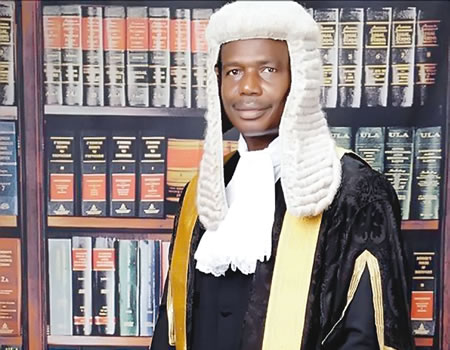
First law office razed, Barrister Adegboruwa raised to the Inner Bar. Between the two periods, we know a lot would have happened to you and your practice. The people out there will want to know the story behind the glory.
My law office was razed down in June 2002 and my wife was pregnant then and we had no savings to start a new office. We were however very strong believers growing up in the Lord then and worshipping at the RCCG headquarters in Ebute-Metta. About 4pm of that day, I was already back in my house in Onike and I had family members and friends who came to sympathise with us. I got up later on and told them that I was going to church for Bible study and some of them were amazed, wondering why I won't sit down for us to plan how to get a new office. I pleaded with them and went to church. For the first time in that year, Pastor Enoch Adeboye came to take the Bible Study and he taught us on the topic Divine Champions, using the story of Samson. I met him after the service for prayers and he told me that one door has closed for God to open a bigger door for me. He said the more I dwell on the incident, the more I would delay what God wanted to do. He then gave some special new notes of about N5,000 which I kept and treasured for such a long time. His words of counsel so invigorated and inspired me that from that day, I never for once thought about any limitations from the fire incident.
Then I had my first lawyer who was working with me then, very energetic young man who joined me as a youth corps members, Mr. Oluwasina Ogungbade. He had a Christian character and was very helpful after the fire. We had no chairs or tables in our new office, so he would come to work to stand and just be moving around the empty office. He would take briefs of clients standing and was never complaining. He is now the head of Chambers of Afe Babalola and co in Ibadan and he was actually part of our interview for the 2019 SAN process.
We started going round the courts, to gather processes to build fresh files, we went to meet lawyers on the other side of our cases to assist us to build our files and by 2004, we were fully settled in our new office. We started recruiting new lawyers and by 2006, it was clear that we would need a new office. So we moved over to NIPOST building in Lafiaji, occupying a very massive space that allowed us to expand the office greatly. We started our own office building and moved to Lekki Phase 1 in 2010. It was tough really but God was on our side to help us overcome that painful experience. Also, we had clients that were very dependable and understanding.
Why do I think only an activist could agree to marry a no-holds-barred activist like you sir.
At the time I met her, my wife was exactly the opposite of what I represented then. The common things that bound us together was love for each other, our faith and love for God. She was the quiet type, very gentle and had no time for activism and protests. She just wanted to settle down and raise a family. It was not difficult for me to blend with her because of where I was coming from. I had no mother, no father, no brother and was virtually an orphan. She quickly took over these roles in my life and we got to understand ourselves very deeply. Being Christians, we maintained a simple life and didn't have any issues at all in setting up the home.
I guess over the years, my wife has seen the person I am, in terms of my convictions and general disposition for good governance and has come to accept that as part of our lives. So too the children. But I guess some of the persecutions that I have suffered after our marriage have also helped to sharpen her own perspective about my struggles generally, especially when I was arrested and charged to court by the EFCC in 2016. I mean she saw the whole scenario, how it all started and became a case of pure oppression and affliction. In that regard, I didn't have to do much to convince her to join me in fighting for my rights and those of others in need.
You are a born-again Christian. When and how did you accept Christ and how do I connect the dots in a tough-talking you and the meek followers Jesus commanded us to be.
I was born into a Christian family, my grandfather was more of a bishop and my father founded a church which he pastored until his death. So, if I say Christianity runs in my family, I will not be wrong. Personally, I had always been a God-fearing fellow, in my own little ways, but I was not an active Christian in my teenage and youth days. The adversities that I went through drew me closer to God, especially when I was to secure admission into the university. I started attending a Pentecostal church around Unilag area, pastored by Reverend Shola Olukolade and he convinced me to give my life to Jesus in those early years and I kept on in that regard until I joined the students union movement in Ife and I became more of an atheist thereafter. That continued until I joined Gani's Chambers as a young lawyer.
One day, a colleague in the office asked to see me privately and I obliged him, since we were classmates. He pleaded with me passionately to take him to my native doctor so that he too could find favour with Gani, like myself as he has observed that since I joined the Chambers, there has not been any rift between me and Gani. And he was very serious about this. So, when I got home that night, I took time to think very well. That it is indeed true that the legal profession is full of all manner of people, some cultists, some traditionalists, etc and since I intend to go far in the profession, I need to fortify myself. I reasoned that if I go and consult a native doctor, chances are that I would meet another lawyer in future who would have a native doctor that may be stronger than my own. If I go and join a secret society, then I will be at their beck and call all the days of my life and if I should go and join politics as a means of connecting power, they may end up sacrificing me one day. So in the final analysis, it would be good to seek a power that is above every other power. One day, I traced the Redeemed Christian Church of God through their loudspeaker, in Ebute-Metta and started attending the church of my own accord. Good enough, I had the opportunity of listening to Pastor Adeboye and I became convinced that I should properly follow Jesus Christ.
Meeting my wife however renewed my faith and trust in God and we both got deeply involved in RCCG matters and became part and parcel of the church. Personally, I believe that Christianity and activism go hand in hand. I read the history of Rosa Park in America. Her resistance was propelled by the book of Acts which states that God is not a respecter of persons, white or black. So, when they told her to stand up for a white man, she remembered that passage and refused to get up. Jesus Christ Himself resisted the Jews all through his days and he even took cane to drive merchants who were turning the church into a market. Through the lives of Mother Theresa, Archbishop Desmond Tutu, Father Matthew Hassan Kuka, etc, it is easy for a believer to be an activist.
Many believe the fate of Nigeria will be settled next year when the country will be 60. What are you looking at and when the country gets to that restructuring turn nearly everyone is desiring, where should the country turn; some are saying parliamentary, some are saying reformed home-grown democracy, among other proposals?
I believe that Nigeria is destined to be a great country but has been very unfortunate to be in the hands of bad leaders. I don't know where you get your drift about Nigeria's greatness at 60 but if at all that should happen, we must have laid the foundation for that greatness even by now. With what is going on presently, that would seem to be a big dream.
Personally, I believe that power supply is critical to the development of any nation, because every other thing depends on it. The cost of generating power has crippled businesses and other initiatives and it has dragged down our national development agenda all these many years. If at 59, we are still experiencing total collapse of the electricity system, we still cannot boast of at least 20 hours of daily supply, then I don't see where we are going to get to at 60 years.
I have interviewed a lot of people and the general consensus is that many are tolerating this particular government because of the believe that there is a succession programme in the pipelines whereby Professor Osinbajo can step in after this current administration. But if that is not going to happen and we have to endure another round of merry go round, then we cannot be talking of greatness at 60.
The Presidential system of government is very suitable for Nigeria, however, the issue is the Constitution. We need to amend the Constitution to reflect a true Federation, especially by decongesting the exclusive list to give way to resource control and true fiscal federalism. As it is now, the only viable government is the federal government, as most of the States cannot survive outside the monthly stipend that they get from Abuja.
Many see you as anti-Buhari and your EFCC ordeal was heavily linked to your opposition to this regime.
I am not anti-Buhari at all. As a matter of fact, I have on many occasions celebrated many policy decisions of his government, such as the courageous amendment of the Constitution to give financial autonomy to the judiciaries of the States, the directive to pay money directly to the accounts of the local governments and the implementation of the TSA accounting system. My issues initially were with the mode of pursuing the anti-corruption crusade as it was lopsided and tailored to rubbish the concept of the rule of law and due process.
All that I did at the beginning was to warn Nigerians that when a leader seeks to topple the rule of law and due process in order to achieve a particular goal, he is only laying the foundation for dictatorship because after he has achieved that goal, he would deploy that same process to hound his opponents. But I was wrongly misinterpreted and labelled as a PDP supporter just to shut me up. I am very happy today that those who shouted me down then are now saying exactly the same thing that I said at the very beginning.
My EFCC ordeal was caused indirectly by my decision to be part of the defence team of Chief Government Ekpemupolo, alias Tompolo and nothing more. But when it became clear that I was only rendering professional service, I think wise counsel prevailed. I can only thank God and all those who rose up in my defence, especially the team of lawyers, journalists, my classmates, activists and my brethren in the church.
Vice President Yemi Osinbajo is going through a turbulent time in the administration. Can you speak to the facts available to you sir, though he has been robustly defended by CAN?
I believe that the Vice-President has been a stabilizing factor for this administration. You remember his visit to the Niger-Delta regions then in the midst of the economic crisis and how that helped to douse tension and settled the pipeline explosions of those times. Then also his campaigns and the fact that he has a good pedigree right from his stint as the Attorney-General of Lagos State.
I believe that what he is currently going through is as a result of permutations for 2023 elections. And if that is the case, you can only leave it in the hands of God because power belongs to God. I do not have the true facts of the case but from what I know about Professor Osinbajo, I cannot ever see in the light of all those allegations. Except something else has happened, the Osinbajo that I know is a very deep man of faith who is driven by transparency and integrity and I will be surprised that he can ever be involved in all these talks going round the social media.
But it is gratifying that his lawyers have taken up some of these issues and some people are already offering apologies and that says a lot about the veracity of these beer parlour stories.
Are you for the return of the Jury system as our judiciary seeks a rebirth?
The jury system cannot work in Nigeria because of our literacy level, absence of needed infrastructure and then legislation. The jurists are supposed to be selected from the society. Even now, single judges are targets of politicians, who are asking judges to step down on account of their marital relationships, on account of religion and even on account of tribe. So, what will happen when we have the jury system?
Then again is the issue of infrastructure. The jury system cannot thrive in a place where judges record court proceedings in long hand, where it takes weeks upon weeks for you to obtain common certified true copies of court proceedings.
Then is the issue of legislation. The Constitution has to be amended to reflect that and that will be a tall order.
What the judiciary needs for effectiveness is funding and independence. If the executive arm of government will fear God enough to allow the judiciary control its own funds, if they will appoint more judges, build more courts and equip them with needed facilities, judges are ready to work and deliver effective justice.